Let’s be honest. If someone lands on your website right now and can’t tell what you do, who you help, and why you’re different within about five seconds, they’re gone. They’ve clicked the back button, found a competitor, and possibly never thought about you again.
That’s not a traffic problem. It’s an offer problem.
An offer is not just a price list. It’s the whole package: what you do, who it’s for, what outcome it creates, and why someone should choose you over every other option out there. Get it right and your website starts doing the heavy lifting. Get it wrong and no amount of ads or social content will save you.
This post is going to walk you through how to craft a compelling offer, how it differs depending on the type of business you run, and how to put it front and centre on your website so it actually converts visitors into customers.
How to Craft a Compelling Offer: What Actually Makes It Work?
Before we get into the specifics, it’s worth being clear on what a compelling offer actually is. It’s not clever wordplay. It’s not your mission statement. And it’s definitely not “we deliver high-quality tailored solutions”—that sentence says nothing, and customers have learnt to ignore it completely.
A compelling offer has a few non-negotiable ingredients.
The Offer Formula: We help [specific type of customer] achieve [desired outcome] without [common frustration or fear].
Clarity is the foundation. The customer needs to understand in plain English exactly what they get and what changes for them as a result. Then you need relevance; ask, ‘is this speaking directly to the problem they’re actually losing sleep over?’ After that, you need a reason to act. A guarantee, a time-sensitive bonus, a free first step, or simply proof that you’ve done this before. Finally, perceived value has to outweigh the price before the price even shows up on the page.
“Your offer is the spine of your entire business. Get it right, and everything else from your ads, your social media, and your word of mouth starts to work harder.”
Crafting your offer by business type
Here’s where most generic marketing advice falls apart. A plumber and an accountant and an e-commerce store selling homeware are not the same business, and they don’t need the same offer structure. Let’s break it down properly.
Professional services: lead with the outcome, not the process
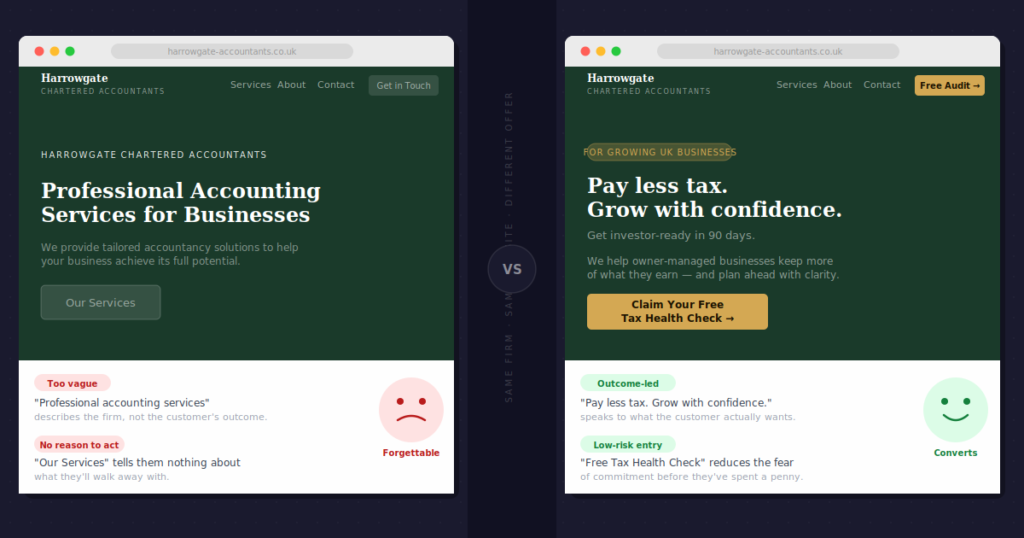
If you’re an accountant, solicitor, consultant, or marketing agency, your clients are not buying your process. They don’t care that you use a proprietary framework or that your team has 40 years of combined experience. They care about what happens to them after working with you.
The offer for a professional services business needs to make the outcome crystal clear. “We help growing Midlands businesses get their finances investor-ready in 90 days” is infinitely more compelling than “professional accounting services for SMEs”. Both describe the same firm. One of them converts.
- State the outcome in your headline, not your service category
- Address the fear: what are they worried might go wrong?
- Offer a low-risk entry point like a free consultation, a discovery call, a quick audit
- Use case studies and testimonials directly next to the offer, not buried on another page
Trades businesses: clear, fast, and no surprises
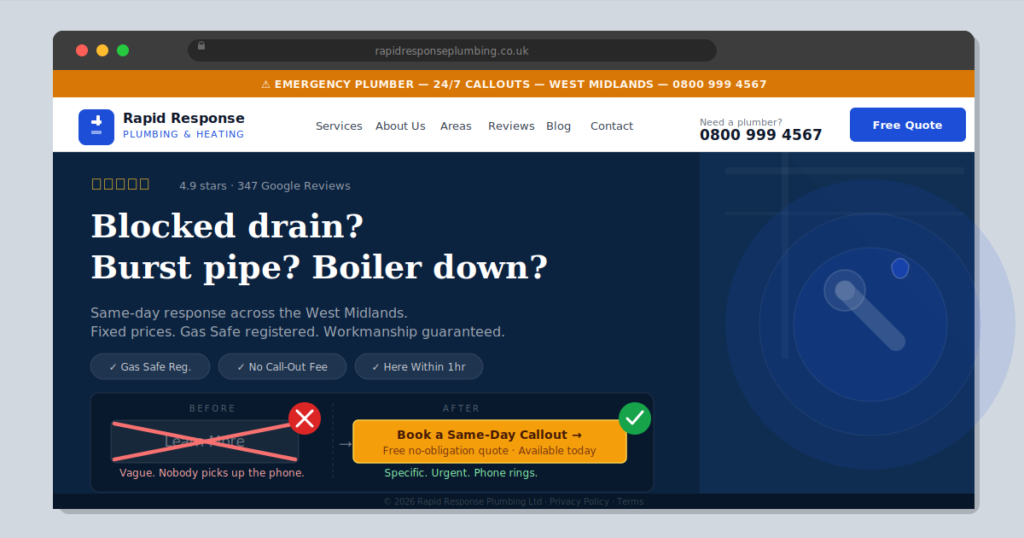
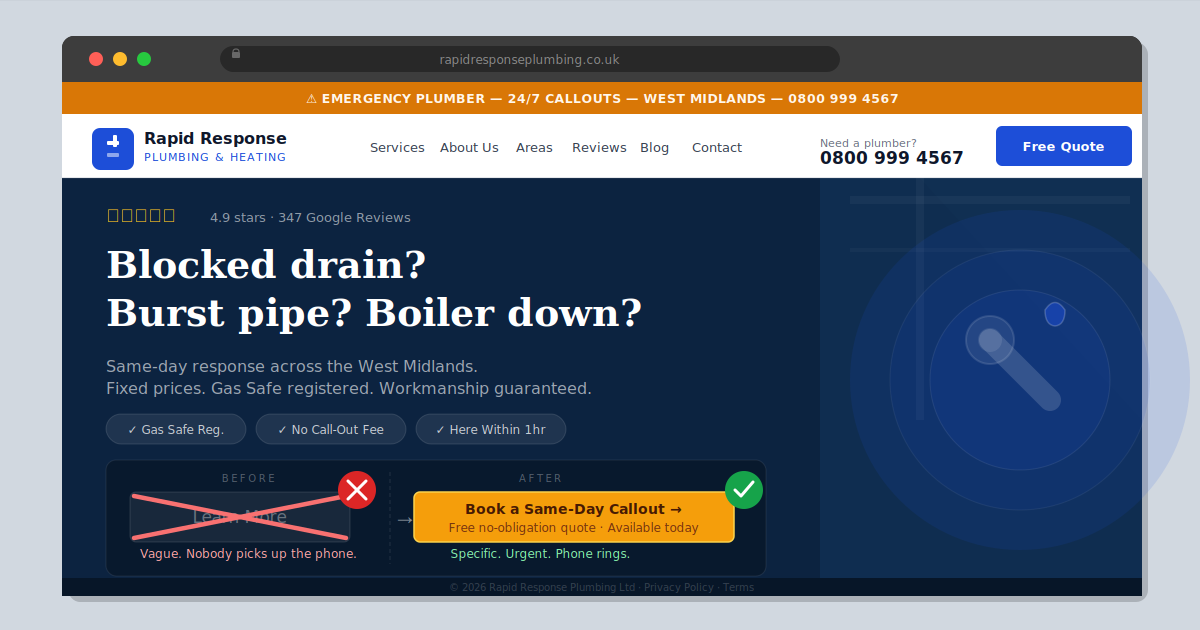
Trades customers are not browsing. They have a leaking pipe or they need a new extension and they want someone reliable, fast, and transparent about price. They’ve almost certainly been burnt before by someone who quoted one thing and charged another, turned up late, or just never called back.
Your offer needs to directly address those fears before they’ve even asked. “Same-day callout, fixed pricing, guaranteed workmanship” is an offer. “Friendly local plumber” is not.
- Mention your response or booking time upfront
- Be specific about the area you cover (people want to know you’re local)
- Price transparency goes a long way. Even a starting-from price beats nothing
- A simple guarantee removes the risk from their decision
- Free quotes and no-obligation call-outs are some of the most effective offers in trades
Offer example for a trades business: “West Midlands plumber available 7 days a week. Free no-obligation quotes, fixed-price jobs, and same-day emergency callouts. 200+ five-star reviews. Call us before 10am and we’ll aim to be with you the same day.”
That offer answers every question a nervous customer has before they’ve had to ask it. That’s exactly what you want.
E-commerce businesses: value beats discounting, every time
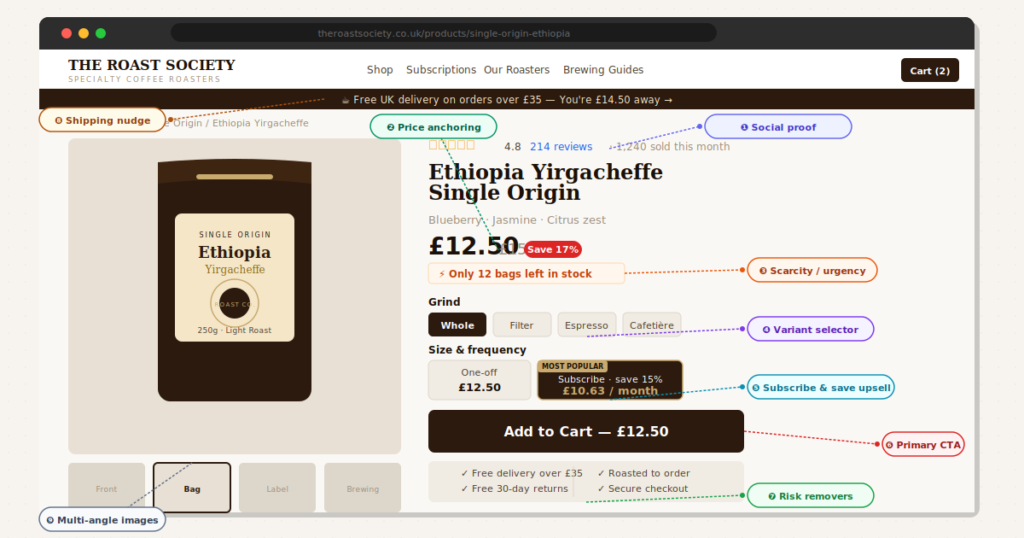
If you run an e-commerce store and your main offer is “10% off”, you are training your customers to wait for a discount, and you are squeezing your own margins. The most successful e-commerce offers do not lead with price. They lead with value, convenience, and confidence.
According to Companies House data, the UK has over 5 million registered businesses, which means your offer must work hard to stand out. Bundles and curated sets let you increase the average order value while making the customer feel like they’re getting more. Free shipping above a threshold is still one of the highest-converting offers in e-commerce. A clear, fuss-free returns policy removes the biggest barrier to a first purchase. Social proof built directly into the offer, e.g., “ordered by 3,400 UK customers this month”, creates urgency without a countdown timer.
- Build your offer around convenience and value, not just price
- Free shipping thresholds outperform flat discounts in most product categories
- Subscription or loyalty hooks increase lifetime value significantly
- Put your returns policy and delivery promise right next to the buy button, not buried in the footer
- Real review counts and recent purchase numbers are social proof that works
Why your website is where your offer lives or dies
You can have the best offer in your industry. If it’s buried on your “About” page or hidden beneath a paragraph about your company history, it might as well not exist.
Research consistently shows that visitors decide within seconds whether to stay on a page. That decision is almost entirely based on whether they immediately understand what’s on offer for them. It is not about how beautiful your website looks, though that matters too. It is about whether the message lands fast.
Think about the last website you left within ten seconds. You probably couldn’t even articulate why you left. You just knew within moments that it was not for you. Your customers are doing exactly the same thing on your site right now.
How to display your offer on your website
Knowing you need a great offer and knowing how to put it on your website are two different things. Here is a practical breakdown of where your offer needs to live and what form it should take.
Your homepage hero section is the most important piece of real estate on your entire website. This is above the fold, meaning it’s what a visitor sees before they scroll at all. Your headline here must state what you do and who you do it for. Not a welcome message. Not your company name in big letters. The offer.
Below that headline, a one or two-line subheading should address the sceptic. Acknowledge what they might be worried about and gently dismiss it. Then one clear call to action, a button that takes them towards becoming a customer. Not “learn more”. Something that reflects the next step: “Get a free quote”, “Book a discovery call”, or “Shop the range”.
Your offer should also appear in your navigation bar if you have a free consultation or signature service, on your services or products pages with specific CTAs for each one, and on any landing pages you’re driving traffic to from ads or social media.
Common mistakes that kill conversions: Talking about yourself instead of the customer. Saying “high quality” and “tailored solutions” when those phrases say nothing. Hiding your offer behind three clicks. Offering everything to everyone. And putting your testimonials on a separate page rather than next to the thing you’re asking someone to buy.
For trades businesses, consider a sticky banner at the top of every page with your key offer and phone number. For e-commerce, product page badges and a clear delivery and returns summary near the buy button can significantly lift conversion. For professional services, a short “what to expect” section directly under your main CTA removes the uncertainty that stops people from picking up the phone.
Put it all together
The businesses that struggle to grow are almost never the ones doing bad work. More often they’re the ones doing great work but failing to communicate it clearly. Your offer is the bridge between what you do and what a customer needs to hear before they trust you with their money.
So here’s a simple exercise. Go to your website homepage right now, pretend you’ve never heard of your business, and ask yourself: within five seconds, can I tell who this is for, what they get, and why I should contact them today?
If the answer is anything other than a clear yes, your offer needs work. And sorting it out does not have to be complicated. It starts with being honest about who your best customers actually are, what problem you solved for them, and saying that in plain English on the page.
Get that right and everything else in your marketing starts pulling in the same direction.
Not sure your offer is landing the way it should? Smart Tribe Digital helps UK businesses get clarity on their offer and build websites that convert visitors into customers. Get in touch for a free website review.